What should a good rap songwriting tool help with?
It should develop connected ideas, setups, payoffs and transitions while supporting cadence, internal rhyme, phrase rhyme and natural performance—not simply generate random rhyming bars.
How many syllables should a rap bar have?
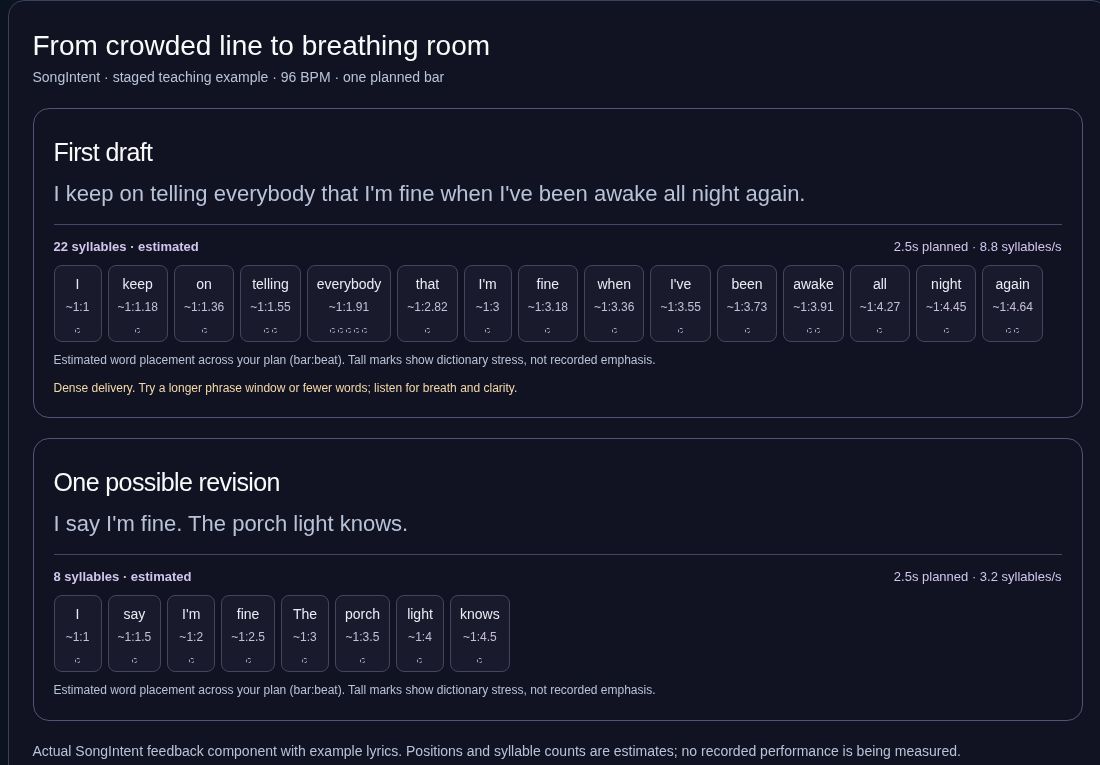
There is no universal number because tempo, subdivisions, pickups and held sounds change the pocket. SongIntent uses the neighboring bar as a cadence reference and warns when written syllables drift outside the chosen range.
Can I enter my own rhyme words and phrases?
Yes. You can type and place your own anchor phrase even when it does not appear in the generated rhyme cloud. AI proposals never have to replace your choice.
Does the tool support internal rhymes?
Yes. SongIntent treats rhyme as a sound architecture that can appear inside bars, at line endings, across bar lines or after deliberate rests.
How does SongIntent avoid robotic AI rap structure?
Sequential rap drafts are reviewed for repeated ideas, missing payoffs, concept overrun, visible technical strain, absent negative space, repeated syllable counts, sentence endings, rhyme positions and grammatical frames. A targeted repair changes only the bars that fail.
How does Punchline Builder work?
Choose Build a punchline in Writer’s Room. Say what you mean, compare up to three endings or use your own, then build a two- or four-bar proposal around that ending. Review and refine the passage, rehearse if useful, then choose Keep these bars. Your existing song remains the destination.
Do I need a beat or microphone to build a punchline?
No. You can write, read aloud, refine and keep the bars with text alone. If you want to rehearse, use the beat and performance controls already in your project. Written timing estimates do not measure your performance.
Can I keep my own ending?
Yes. Enter your own ending without generating options first. Keep this ending protects the selected wording while you develop or refine the surrounding passage. A conflicting lock needs your decision before the result can be accepted.
Does Punchline Builder need another plan or audio credits?
One existing writing assist covers up to three endings, one two- or four-bar draft and one targeted repair for the same idea and passage. You can use your own ending instead. Extra versions or repairs cost one assist each. Free and paid plans use the same rule. Manual editing, reviewing, rehearsal and acceptance are unmetered. Text work does not use Song Renders or Reference DNA audio minutes.
Can SongIntent convert a mumbled rap flow into lyrics?
Yes, if the performance contains rhythmic articulation and word-like sound changes. Pure humming should use Melody Sketch instead because it does not provide enough speech information for reliable lyric matching.